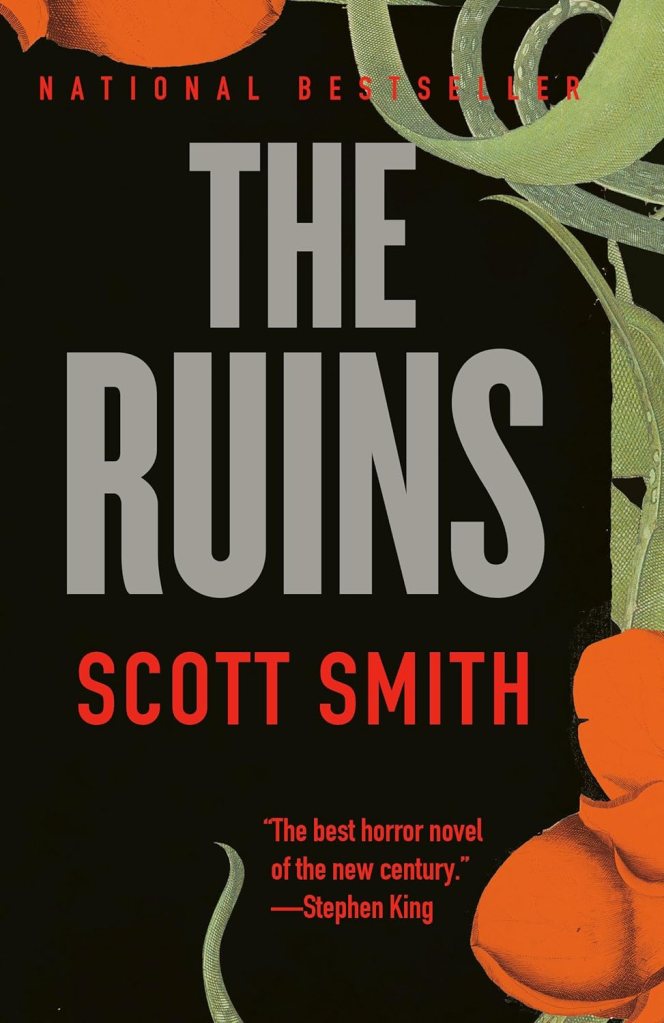
Title: The Ruins
Author: Scott Smith
Year: 2006
Publishing Details: First Vintage Books, Random House Inc., New York, Mass Market Edition, August 2007
Genre: Horror
Topical Category: Man-eating Plants
Synopsis and Background:
It’s August and a small group of young people go on vacation. They wear skimpy swimwear, drink booze, make out, and generally eat drink and be merry. Then they decide to go on a little adventure. A day trip. Into a forest they have never been to before. The harbinger of impending doom that they meet on the way there warns them to turn back, that it is a ‘bad place’ but they continue blithely on…
If, from reading this short description, you finished it off in your head with “and then they start to get killed off, one by one” you have detected the correct genre. However, in this case it is the Mexican jungle near Cancun that fills in as the forest, instead of, say, an abandoned summer camp, Southern California, or the Pacific Northwest. And instead of a log cabin or haunted house or abandoned sanitarium there are The Ruins, an archeological dig of an abandoned mining encampment.
And, while The Ruins starts like your average horror movie, it does have a few surprises in store. Americans Amy and her boyfriend Jeff and Stacy and her boyfriend Eric are on vacation. While there they meet Mathias from Germany who is searching for his missing brother and ‘Pablo’ from Greece who thinks it is funny to give them a joke name (his friends go as Don Quixote and Juan, respectively). Using a map that Mathias’s brother drew on a napkin before he disappeared, Jeff and co. (most of whom speak no Spanish), Mathias, and Pablo (who speaks no English or Spanish) decide to travel to the location of the archeological dig marked on the napkin map and find Mathias’s brother.
In the jungle near a native village they find the ruins. A hill covered in leafy vines with a few tents at the top, arranged around an abandoned mine shaft. The hill itself is surrounded by twenty feet of bare ground, almost like the land has been deliberately razed. Unfortunately, Amy is taking pictures and accidentally steps onto the hill. The native villagers then force all the young people to climb the hill at arrow and gunpoint and do not allow them to leave.
At first it seems like the majority of the danger stems from the villagers. Under a mound of leafy vines they find Mathias’s brother, shot full of arrows. And if they stay on the hill to avoid a violent death, they will have to contend with thirst and starvation with little hope of rescue coming in time. Things become even more fraught when Pablo goes down into the mineshaft after hearing the sound of a cellphone ringing and accidentally falls and injures his spine. They have no real medical supplies or expertise, tensions are running high, and water is starting to run out.
But the protagonists have something much worse to contend with than hunger or gangrene. They don’t realize it at first, but they are surrounded by a malevolent intelligence that seeks to suck them dry of hope, as well as flesh and blood. They are not the first group of people to be lured to the ruins, will they be the last?
SPOILERS BELOW
My Thoughts:
Scott Smith is clearly familiar with genre conventions and does try to do the unexpected with this book. He calls out these horror conventions in a short sequence where he has the characters discuss ‘what if they made this into a movie?’. They correctly identify their ‘roles’: Jeff is the ‘The Nice Guy With the Monosyllabic First Name’ or ‘Hero’, Amy the ‘Good Girl’, Stacy the ‘Slut’, Eric the ‘Funny Guy’, Mathias as ‘Possibly the Villain’, and (the unspoken) Pablo as ‘the First Red Shirt Who Dies’. But Smith goes out of his way to kill the characters off in an unexpected order and in unexpected ways. For example, the typical ‘final girl’ Amy, the reluctant one, dies first.
I will also call the choice of the evil vine as antagonist unexpected. Not to me, because thanks to my long-standing love of man-eating plants that’s half the reason I even read this book in the first place. But I can see how, if you were simply looking for a horror read and didn’t have that plot point spoiled for you, you would have been pretty darn surprised on page 222 when the evil vine sprung to animate life. And, though I read this book mostly from the comfort of my own bed with my electric light cheerily burning, I admit to feeling actually scared. Or at least perturbed and paranoid. I have cast at least one wary glance at a Clematis since I finished it.
Scott Smith also works a variety of other human fears and phobias into his writing in order to build tension and give the book an unsettling atmosphere. Fears of being lost in a foreign country, fears of foreign people with unknown motives, language barriers during moments of crisis, injury, pain, disease, insects, filth and contamination, darkness, violence, madness, and betrayal by those close to you are all worked into The Ruins to great effect. The characters are not perhaps likable, but they are very human, believable, and you do sympathize. I found that while reading it was impossible not to think, “How would I react if placed in this situation?”
Now, the vine.
I say, in all seriousness, that the evil vine here is like a greatest hits collection (intentionally?) of nearly every man-eating plant in the last 150 years, especially for the short stories from the 1870s to the 1930s (see my earlier post Man-Eating Varieties and Other Unusual Flora for more information). This lethal liana has (nearly) it all:
- The tendrils that move like ‘serpents’ or ‘tentacles’
- The skulls and bones piled up near the roots
- A stinging, blistering sap or poison that the plant exudes
- Sucking up blood and other bodily fluids
- Dissolving and ‘eating’ flesh
- Throttling or suffocating victims
- Blood-colored flowers that bloom after the plant is fed
- Flowers with ‘tongues’ that make sounds like moaning or singing
- The body horror of vines and roots crawling through living human flesh like worms
All that are really missing are:
- A poisonous, soporific and intoxicating odor that attracts prey
- Blooms that resemble the faces of its dead victims
- An enormous pitcher or flytrap with thorns/teeth
But I can see why Scott Smith chose not to include those as they kind of give the game away. As it was, the main characters were kept guessing until pg. 222 of 509, which is pretty good. Well, not for them. Also, the characters wish there was a soporific odor to knock them out. Unconsciousness or intoxication would have been a mercy.
I have been referring to the vine as ‘evil’ throughout this review because it very much is. While most man-eating plants are simply natural or unnatural organisms that are only trying to live or reproduce, this vine is a creature of malice. It plays mind games, raises hopes and then crushes them, and then it even laughs. I would go so far as to call it ‘demonic’.
Bear with me. Demons, in the sense of evil spirits/fallen angels, are described in traditional Christian theology as having certain features and goals. In brief, demons began as angels and fell away when they refused to obey God. As rebellious angels, they retain the powers of higher spiritual beings but have dedicated themselves to tempting humans to ruin. They are hostile intelligences capable of manipulating the material world to their own wicked ends. Places, things, and persons are all vulnerable to diabolical infestation. There have been plenty of movies made showing demonic infestation of houses or possession of people.
As beings that ‘seek the ruin of souls’, demons try to control people through fear and suffering, even looking into people’s memories and imaginations to determine how best to tempt or manipulate them. The Exorcist (1973) shows this well in the demon’s attempts to convince Father Karras that it is in contact with his dead mother. Theologically, souls are ruined when they are separated from God by mortal sin. This would include things like pride, greed, envy, wrath, lust, gluttony, and even despair in hope, murder, atheism, and suicide.
In The Ruins, the vine (with the cooperation of the local villagers) traps successive groups of people on a hill. Oddly, the plant does not seem concerned with escape. All it would take is one escaped victim to spread the seeds/spores/shoots to the surrounding jungle and, presumably, to the rest of the world. But the plant seems content to trap each small band of humans and gradually put the screws on them, breaking them down emotionally and psychologically until their baser natures are revealed. Rather than attempt escape, the plant seems satisfied to torture its chosen vicitims, letting them have just enough hope of survival to string them along and plunge them into greater and greater despair.
The plant, as we learn by the end, could very easily have killed all of the characters within minutes of their arrival. It could have drained them immediately or strangled them. It could have pushed them all down into the mineshaft, broke their bones, and then killed them. It could have drunk all their water (as it does in the end) or broken down all their food. Prevented them at any point from walking around, trying to write signs, trying to communicate with the people surrounding the hill. But it didn’t. It let them live so it could slowly show them that they weren’t the ‘good’ people they thought they were and that they had absolutely no chance of escaping. This sounds much more like a demon to me than a normal, earthly organism.
The vine displays preternatural abilities. It can mimic the sound of a cell phone to lay a trap, can decide to consume some things and not others (like the rope), it can understand the meaning of words like ‘Nazi’ or ‘slut’. It intuits that Eric is jealous of Stacy cheating on him and creates false dialogue for that scenario to drive Eric even further around the bend. It even mimics the smells of specific foods to taunt it’s starving captives, foods like apple pie that it is unlikely to have ever directly experienced in order to mimic. The plant displays a sadistic streak, intelligence, and knowledge beyond any normal plant or animal.
In fact, the vine only starts killing people off when they have completely lost faith in themselves and each other. It speaks to them echoing back the horrible things they have said to one another. It kills Amy, finally, when she has come to feel that Jeff hates her and would leave her to die and when she blames herself for the whole debacle since she was the one who stepped into the vine in the first place. It lets Jeff make a run for it and die when he realizes all his anger and control issues and pride were pointless and he can do nothing to save the others or himself, then drags him back to consume him. It goads Eric to skin himself and then murder Matthias. But Matthias only dies after the vine taunts him and mockingly puts Jeff’s hat on his dead brother’s head. Then it drags Matthias’s body away…but not Eric’s right after Stacy has just said, “I don’t know if I can handle it…watching him die.” Setting up a scenario where Stacy mercy-kills Eric and then commits suicide. The vine plays them like a fiddle and makes sure they have lost all hope in everything before it destroys them. Or has them destroy each other.
I think the best way to ‘prove’ my demon theory would be for someone to have confronted the vine with Christian symbols and trappings like a crucifix or holy water or an exorcism. But other than Jeff being born Episcopalian, they got nothing. So I guess we will never know. My backup theory is an alien from outer space. Maybe one marooned on earth and driven insane with hatred like the computer from the Harlan Ellison short story “I Have No Mouth And I Must Scream” (1967)? Maybe whoever first dug the mine shaft dug too deep and accidently released the alien from its buried spaceship? It’s a possibility.
It is, of course, the case that we, the readers, are not meant to know what exactly the origins of the evil vine are. It resists the characters’ attempts to classify it or make it legible and that is part of what makes it scary. When you know what the source of the evil is or it’s motivations you can understand it, rationalize it, bargain with it, etc. When you don’t know anything about it other that it is evil… you are helpless. Not just physically, although that too, but the human brain needs to make sense of the world, needs to slot the phenomena it encounters into its worldview. The fact that my brain went directly to The Exorcist-style demons says something about what I was expecting, I’m sure. But maybe not so much about Scott Smith’s intentions.
Although…interestingly, salt can be used to repel demons. And holy water, also a demon repellent, contains salt. In The Ruins the ground all around the vine has been salted to contain it. Make of that what you will.
The number of times during my reading marathon a pointless sex scene does nothing to advance the plot: Still 4.
The number of times a lesbian character deserved better: Still 1.
Rating:
3/3 Entertainment Value: This was a tense read and also met all my man-eating plant expectations. More thought provoking than I was expecting. Very good.
3/3 Quality: Well put together book, especially in terms of making its characters seem like real humans and not cardboard cut-outs.
1/3 Originality: Scott Smith does a good job remixing already established elements but the connection between ‘exotic’ travelog narratives and man-eating plants is a hundred years old. And horror stories of naive young people getting picked off one by one at an isolated location are very common. Even the ‘downer ending’ has been sprouting up again and again since…let’s just say Night of the Living Dead (1968)/ the retirement of the Hayes code.
1/1 Exceeds Expectations: All too often man-eating plants are promised or hinted but never delivered. This book delivered.
Total Score: 8/10
Best Quote(s):
“The hill was rocky, oddly treeless, and covered with some sort of vinelike growth—a vivid green, with hand-shaped leaves and tiny flowers. The plant spread across the entire hill, clinging so tightly to the earth that it almost seemed to be squeezing it in its grasp. The flowers looked like poppies, the same size and color: a brilliant stained-glass red.”
“The Ruins does for Mexican vacations what Jaws did for New England beaches.” – Entertainment Weekly
 Lady Scientist Reads
Leave a comment