
Title: The Plants
Author: Kenneth McKenney
Year: 1976
Publishing Details: Bantam Book, published by arrangement with G.P. Putnam’s Sons, February 1977
Genre: Science Fiction, Horror
Topical Category: Man-eating Plants, Eco-horror
Synopsis and Background:
I love love love man-eating plants. Sadly, they are few and far between. More often they are some variants of man-killing plants or even man-threatening plants, but I have labeled this topical category ‘Man-eating plants’ because I live in hope.
The history of how ‘man-eating plants’ even ended up becoming a thing is a fascinating tale and one that I have overviewed in a separate post of its own (Man-Eating Varieties and Other Unusual Flora). For a long time the only places to find them were the odd short story or travelog, as a cameo in a science fiction film about something else, or in metaphorical fiction clearly about another topic. I’d say they hit the big time with the off-broadway production of Little Shop of Horrors (1982) and its film adaptation.
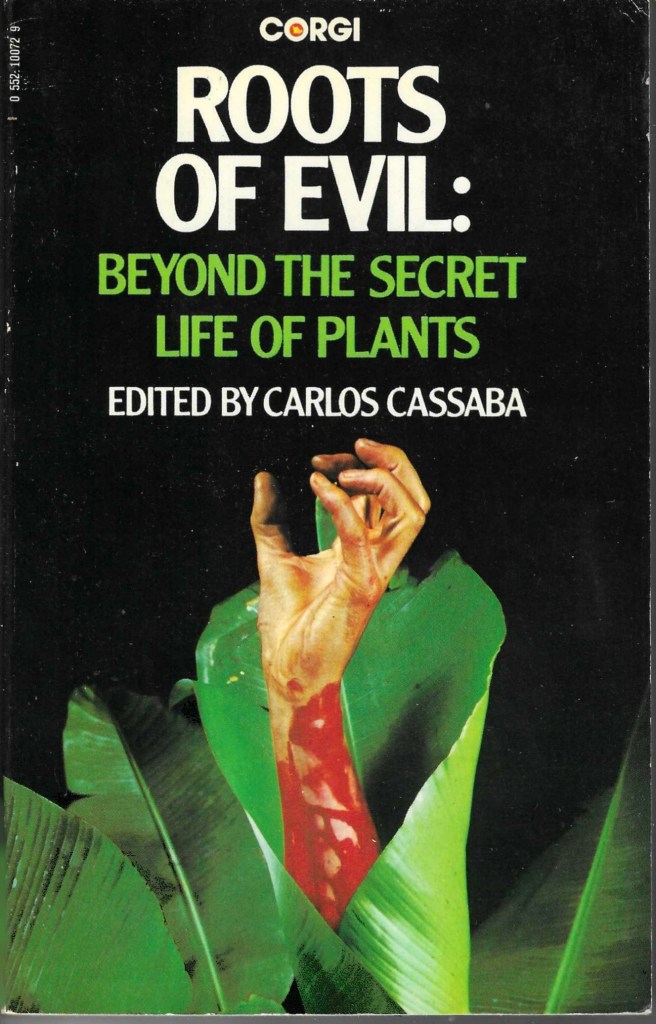
But before that happened, there were the 1970s, filled with tales of nature run rampant and/or ecological collapse brought on by greedy humans. Also, in 1973, The Secret Life of Plants was published. Authored by Peter Tompkins and Christopher Bird, it claimed to be a record of real experiments that revealed that plants were sentient. That they could be hooked up to polygraphs, think, feel emotions, listen to music, telepathically communicate with humans. etc. The book was roundly dismissed by scientists for its pseudoscience and unproven, unrepeatable experiments. But it became a non-fiction New York Times bestseller.
Accordingly, in 1976, Kenneth McKenney wrote a book entitled The Plants that purported to be “A superbly crafted novel of horror and high suspense”. The frontispiece of my copy says, “What Alfred Hitchcock did in The Birds… What Peter Benchley did in Jaws… Kenneth McKenney does in the newest, most exciting excursion into plausible terror yet, THE PLANTS.” Wow. Those are some high expectations to raise. Will they be met?
“But they were men too close to the soil to remain unaffected by the squash and its size and the reactions it was beginning to cause. They were beginning to feel its presence like fear.”
Oh no.
*sigh* The book opens in Brandling, a tiny English village. The whole country is experiencing one of the warmest, lushest summers on record and the plants are growing like mad. Accordingly, Charlie Crump, not much of a gardener, has had an enormous ‘squash’ sprout up in his garden overnight.
I say ‘squash’ because, as a resident of the United States, I have always called these vegetables zucchinis. Zucchini is the Italian loan word, but for some reason the English seem to use either the French loan word ‘courgette’ or their own term ‘marrow’ or ‘vegetable marrow’. Or, it seems, the term ‘squash’. Now, in my region of the world we do call the yellow variety of the vegetable ‘summer squash’. There is also the very cute breed called the ‘pattypan squash’. But usually when we say ‘squash’ we are referring to ‘winter squash’, squash, usually with orange or yellow flesh, and a very hard exterior that keeps much longer than ‘summer squash’.
What I think is absolutely wild is that both summer (zucchinis, pattypans, etc.) and some winter squashes (acorn, delicata, and spaghetti varieties) are all the same species, Cucurbita pepo. Your average orange pumpkin (the kind you carve into jack o’lanterns) is ALSO C. pepo.
The two other major squash species include Cucurbita maxima (Hubbard, kabocha, and red kuri squashes) and Cucurbita moschata which includes the butternut squash and the Dickinson pumpkin. That is the one made into delicious pie filling. Oh and in Japan, all squashes and pumpkins (from the zucchini to the red kuri to the carving pumpkin) are referred to as ‘kabocha’.
I digress.
So Charlie Crump has a giant zucchini and the other locals give him a hard time about it. Especially after everyone realizes it has continued to grow after being picked. Meanwhile, Philip Monk, popular science communicator and environmental crusader, suspecting that ‘all mankind is in danger’ decides to consult a colleague and then head home to his wife and kids in Brandling…in case the giant ‘marrow squash’ is a harbinger of doom. Charlie, sick of being made fun of, takes an ax to the giant zucchini. It does nothing.
Meanwhile his neighbor, Mabel, is trying to trim her rose bushes. But whenever she tries she gets pricked by a thorn. Deborah, Philip’s daughter, stops by to let Mabel know that plants can talk (to each other) and that she has heard them. Interesting.
Philip’s colleague Martin listens to Philip’s theory that the ‘squash’ is a portent of an environment out of balance. Martin agrees wholeheartedly and says the plants are ‘just about ready to rebel’. Martin gestures wildly and says, “But what would you say if I told you I believe that the plant kingdom morally disapproves of what man is doing to the world?’ Um. Martin’s evidence for this assertion is Cleve Baxter’s experiments with plants and lie detectors (most notably popularized in….The Secret Life of Plants). Martin then proceeds to tell Philip that he thinks the plants are controlling the weather and that his colleagues don’t believe him and want to oust him from his university position.
Um.
So Philip Monk heads home. His wife, as it turns out, irons t-shirts and despairs over the children. Jacob is the older, precocious and interested in science. Deborah the younger and ‘fantasy prone’. Both of them miss their father who is ‘very busy’. So we have another workaholic with a failing marriage. Seems to be a common trope with 1970s books.
The first fatality of the ‘plant rebellion’ is Charlie Crump, who is walking home at night, hears plants rustling, starts running wildly, is tripped by a rose bush, and collides head first with a wall. Deborah has a psychic vision of this for some reason. So Philip sets out to discover what it is that the plants want.
As the peril begins to mount, the plants cut the phone lines, and it is up to the precious few humans in Brandling who can hear the voices of the plants to warn of calamity and try to broker peace between the human and vegetable kingdoms.
SPOILERS BELOW
My Thoughts:
This novel seemingly set out to do a couple of things: scare you, impart an ecological message, and make you sympathize with its characters. It failed at all these things as well as at meeting *my* expectation of finding interesting killer plants.
I was not invested in the protagonist’s marriage and he and Elizabeth were both kinda annoying. The kids were written like the worst of 70s TV child acting. Everyone felt like replaceable stock figures and I didn’t care too much if they lived or died. Elizabeth especially swung from happy to fearful to angry to content at the drop of a pin. She felt like a caricature of the hysterical woman.
Meanwhile, the ecological message was somehow both pointlessly vague AND heavy handed. Mostly it was imparted by spouting vaguely philosophical exposition, which was boring. At no point did it sound scientifically credible. And all the characters’ impressions of impending doom seemed massively outsized compared to the events that inspired them. The writing style had a lot of telling and not much showing.
As for the fear factor…zucchinis are not intimidating. Rose bushes are a bit better. Sunflowers, still no. The village constable being mauled by a hedge filled me with no trepidation whatsoever. This book was not scary at any point. They also never explain why Debby specifically has the plant Shining. And I still don’t understand why the sunflowers demanded a human sacrifice. Calling this a ‘killer plant’ book is technically correct but kind of a stretch.
I was mildly amused by the scene where Philip and the kids save a small bird from a net and let it go, while not minutes before talking about how England used to be a jungle where big swamp dwelling dinosaurs lived but then all died for some unknown reason. Ah ha, not all of them. Sure, songbirds don’t look much like Megalosaurus, but it still counts.
And that’s all there really is to say about this book.
The number of times during my reading marathon a pointless sex scene does nothing to advance the plot: 4 (As Philip and Elizabeth are milquetoast people who spout random emotional declarations and pseudo-philosophical speeches about nature, that is what you get for the ‘love scene’. It has nothing whatsoever to do with the killer plants.)
The number of times a lesbian character deserved better: Still 1.
Rating:
1/3 Entertainment Value: I really would have been more entertained doing nearly anything else. Like cleaning my oven or folding socks. Stir-frying zucchini.
2/3 Quality: This book was competent. It was edited, spellchecked, and grammatical. It kept track of its own plot, boring though it was. The ending was unsatisfying, but the whole book kind of was so. Consistent.
0/3 Originality: This was clearly a riff on The Secret Life of Plants and the post-Jaws eco-horror boom. Nothing more, nothing less.
0/1 Exceeds Expectations: This book is boring to read. You will not be invested in the characters. Do something else instead.
Total Score: 3/10
Best Quote(s):
“It’s happening all over the world. Us. The Americans, everyone. The Russians have been working on plant mutations for years. Their long term goal is the control of all plant growth…My God, talk about disciplining nature.”“Nature may turn out disciplining us.”
“Tell me,” he asked tartly, “How do you arrest a rose bush? Florabunda or any other kind?”

 Lady Scientist Reads
Leave a comment