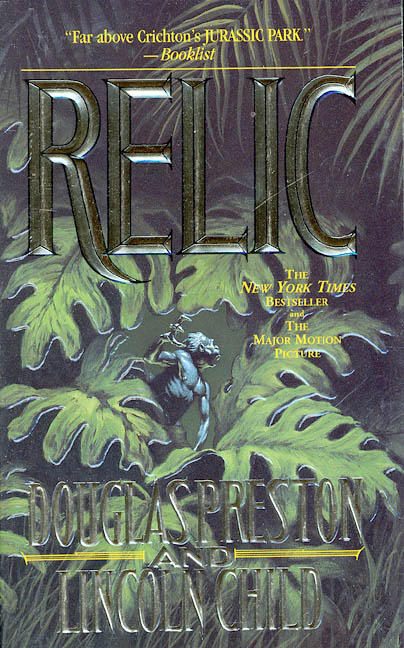
Title: Relic
Author: Douglas Preston and Lincoln Child
Year: 1995
Publishing Details: A Forge Book, Tom Doherty Associates, Macmillan Publishing Group, LLC. First Mass Market Edition, January 1996
Genre: Science Fiction, Horror, Mystery
Topical Category: Mutant-on-the-loose
Synopsis and Background:
“Doug pitched me a murder mystery set in the museum that was literally called ‘Zero at the Bone’ and it wasn’t all that good, but that wasn’t his fault. It was because murder mysteries were a dime a dozen and I told him that and I suggested that we write a thriller– a techno-thriller à la Jurassic Park, set in a museum which is the ideal place for it.”
- Lincoln Child (Excerpt from ‘DOUGLAS PRESTON AND LINCOLN CHILD TALK NEW PENDERGAST NOVEL/ NORA KELLY SERIES ON ABOUT THE AUTHORS TV’ YouTube video, channel About the Authors, Premiered July 27th, 2023)
The above quote does a great job encapsulating the plot of Relic, from the behind-the-scenes-museum feel, to the questionable use of genetic technology, to the Murphy’s Law of human incompetence that precipitates disaster. But it does not quite capture the mood.
Relic is a book that builds its mood relentlessly with a less-is-more approach that pays off in spades. It opens with a flashback to John Whittlesey’s 1987 expedition to the Amazon. He went in search of a lost tribe, the Kothoga, and was never seen again. But he did manage to ship some artifacts back to the museum, including a stone figure of the Kothoga’s devil-beast, the Mbwun. The crates containing the remains of Whittlesey’s expedition are stalked by tragedy from Brazil to Louisiana and finally to the American Museum of Natural History in New York City.
It is there that Margo Green is introduced, PhD student in ethnopharmacology, and her advisor Dr. Frock, originator of a theory called the Callisto Effect:
“Combining chaos theory and Darwinian evolution, Frock’s hypothesis disputed the commonly held belief that life evolved gradually. Instead, he postulated that evolution was sometimes much less gradual; he held that short lived aberrations–”monster species”– were sometimes an offshoot of evolution. Frock argued that evolution wasn’t always caused by random selection, that the environment itself could cause sudden, grotesque changes in a species.”
Needless to say, Frock’s work is controversial. But when three people, including two children, are found ripped to pieces in the museum’s vaults, doubt begins to creep in… And the deaths don’t stop there.
Present to solve these crimes are the hardboiled Lieutenant Vincent D’Agosta from Queens and the slim, pale, erudite FBI agent Pendergast. (Pendergast will be our guest starring Sherlock Holmes-type and a breakout character. As of 2024 there are 21 Pendergast novels with another to be released this July). In the Mayor-from-Jaws role we have Dr. Ian Cuthbert, the museum’s deputy director and Lavina Rickman, chief of public relations. Our Carl Kolchak for the duration is William Smithback, Jr. , an investigative journalist who is hampered at every turn in his attempts to tell the true story of the mysterious deaths.
The museum is about to launch a gala exhibition, Superstition, in which the Mbwun figure will feature prominently and the top brass don’t want to believe that something is lurking in the vaults beneath the museum. Something inhuman. Something deadly. The show will go on, museum leadership insists, with Special Agent Coffey sent in by the governor to make sure that nothing stops the gala, no matter how many people get decapitated in the interim. Coffey, as you might imagine, will be our Dwayne Robinson from Die Hard (feel free to imagine him being played by Paul Gleason. I did.)
Is the cause of all this tragedy the relic sent back from the Amazon? Does the curse of the Kothoga haunt the museum? Is it a crazed killer with a three-taloned weapon like Agent Pendergast posits? Is it the manifestation of Dr. Frock’s Callisto Effect set loose in modern New York? As the death toll rises, our main characters race against time to prevent a tragedy, or failing that, simply to live through the most terrifying night of their lives.
SPOILERS BELOW
My Thoughts:
I was introduced to Relic through the movie adaptation The Relic which came out in 1997 and was the first R-rated film I ever saw. The movie has quite a few points of difference, the story is moved to the Field Museum in Chicago, Agent Pendergast is removed with Lieutenant D’Agosta taking center stage, Margo Green becomes a doctor of evolutionary biology, and the Mbwun becomes simply ‘the Kothoga’. It is a fantastic movie. The writing is admittedly cheesy and takes a nod or two from Jaws, among other things. But the suspense is solid and the special effects done by Stan Winston Studios are top tier for 1997.
Relic is an enjoyable book in its own right. The characters are recognizably stock, but that never once detracts from the story. It helps that real life is in fact filled with stubborn bureaucrats, curious reporters, confrontational policemen, eccentric museum curators, cloistered scientists, and overworked grad students. The Jurassic Park references are there but the substantially altered setting along with the fact the Dr. Frock is no Ian Malcolm, keep them unobtrusive.
I love the gradual solving of the mystery from both ends, with Pendergast taking one side of the problem and Margo, Dr. Frock and Smithback working from the other side until they meet in the terrifying middle. I also like the humorous human touches, like the DNA technician who thinks he’s being pranked with gecko DNA or all the employees getting wise to ‘the Museum Beast’ and starting to call in sick, quit without notice, etc. They were the smart ones.
And now the monster.
Dr. Frock’s theories, which I think were inspired by a common misunderstanding of the ‘punctuated equilibrium’ of Eldridge and Gould and the ‘hopeful monsters’ of Goldschmidt, are…unique, to say the least. There is an extended scene where he insists that rapidly evolved super-predators are the ultimate cause of mass extinctions, before going extinct themselves. Frock suggests that an Anomalocaris-like predator caused the end-Cambrian extinction. And that a population of aberrant creatures, like the Mbwun, not large but fast and intelligent, were responsible for killing off the dinosaurs. He argues that such a creature might come about from convergent evolution and start to prey on the human population, driving it to its own extinction.
Which is a great premise for a science fiction novel but scientifically dubious. The truth of the matter (which you don’t learn the full extent of till the last chapter, through there are clues) is much more complex than Dr. Frock’s theory.
The actual line of causation for this story seems to go:
- During Dinosaur times (the Carboniferous is mentioned once but they keep saying ‘angiosperms’ so I am going to ignore that) a retrovirus picked up a bunch of reptilian DNA (hence the three-clawed forelimbs).
- The virus formed a symbiotic relationship with a lily-pad-like plant.
- Specimens of this ancient flora were preserved on a plateau or tepui in Brazil.
- Somehow, the people living there figured out that if you feed the plant to a human the virus uses its reverse transcriptase to mutate the human into something partly reptilian.
- Because the virus codes for a ton of animal hormones that are found in the human hypothalamus the victim needs to eat the plant fibers to prevent horrible pain from its body trying to revert.
- When the victim cannot get any more of the plant, they compensate by ripping out people’s hypothalami and eating them. But the concentration is so much lower than the hormone concentration in the leaves that they need to feed almost daily.
Let’s walk through that and see how plausible it is:
- RNA viruses can ‘steal’ DNA from their hosts and use it to code for ‘chimeric proteins’. At least humans. Perhaps it works for dinosaurs too.
(Ho, J. S. Y., Angel, M., Ma, Y., Sloan, E., Wang, G., Martinez-Romero, C., Alenquer, M., Roudko, V., Chung, L., Zheng, S., Chang, M., Fstkchyan, Y., Clohisey, S., Dinan, A. M., Gibbs, J., Gifford, R., Shen, R., Gu, Q., Irigoyen, N., Campisi, L., … Marazzi, I. (2020). Hybrid Gene Origination Creates Human-Virus Chimeric Proteins during Infection. Cell, 181(7), 1502–1517.e23. https://doi.org/10.1016/j.cell.2020.05.035)
- RNA viruses do form symbiotic relationships with plants, and have since ancient times.
Dolja, V. V., Krupovic, M., & Koonin, E. V. (2020). Deep roots and splendid boughs of the global plant virome. Annual Review of Phytopathology, 58(1), 23–53. https://doi.org/10.1146/annurev-phyto-030320-041346
- Mesozoic plants have survived to the present day, virtually unchanged, like ginkgos and cycads.
Zhao, YP., Fan, G., Yin, PP. et al. Resequencing 545 ginkgo genomes across the world reveals the evolutionary history of the living fossil. Nat Commun 10, 4201 (2019). https://doi.org/10.1038/s41467-019-12133-5
- RNA viruses do use reverse transcriptase to mutate their hosts and can alter the genomes of whatever organism they infect. People actually take advantage of this fact to use viruses as a vector to insert new transgenes in gene therapy.
Poletti, V., Mavilio, F. Interactions between Retroviruses and the Host Cell Genome. Molecular Therapy – Methods & Clinical Development 8 (2018). https://doi.org/10.1016/j.omtm.2017.10.001
However, the potential unpleasant side effects include, primarily, cancer (“resulted in severe adverse events caused by vector-induced proto-oncogene activation”) not, uh, becoming a reptilian mutant.
- Viruses can create proteins that closely mimic human peptide hormones. The hormones expressed by the pituitary gland/hypothalamus are peptide hormones.
Huang Q, Kahn CR, Altindis E. Viral hormones: expanding dimensions in endocrinology. Endocrinology 2019; 160(9): 2165–2179. https://doi.org/10.1210/en.2019-00271
- Viruses can modulate relationships between plants and insects (animals) by affecting plant phytohormone production in order to encourage insects to eat more of the plant and thereby spread the virus.
Pan, L. L., Miao, H., Wang, Q., Walling, L. L., & Liu, S. S. (2021). Virus-induced phytohormone dynamics and their effects on plant-insect interactions. The New Phytologist, 230(4), 1305–1320. https://doi.org/10.1111/nph.17261
So, conceptually, given what we know about viruses now, the chain of cause and effect in Relic is not entirely insane. The major obstacle is that viruses that infect plants can alter plant DNA and produce plant hormones. While viruses that infect humans (or other animals) engage in horizontal gene transfer with humans, alter human DNA, and produce chemicals mimicking human hormones. And plant and human hormones are very different in terms of structure and complexity. A virus that does one does not seem likely to be able to do the other as well. But I was surprised reading up on this how much we have learned about viruses since 1995 that doesn’t blatantly contradict the fantastical premise of Relic, at least at a superficial reading.
Mbwun itself is very sparsely described in Relic, apart from its stereoscopic eyes, thick bones, and combination of scales and hair. I did like the design of the Kothoga from the movie adaptation. It was much more of a fantastical blend of different animals (instead of just human and reptile/dinosaur). I liked the tiger hips and gait, gecko feet and tail, and the mandibles reminiscent of a stag beetle.
I think that the movie Kothoga design managed to look like a chimeric but realistic animal. It avoided any uncanny valley suggestions of its human origins. This is probably due to the great lengths the special effect technicians went to to disguise the human performer inside the Kothoga suit and the use of CGI to enable the creature to run and jump without the physical limits of an animatronic. In contrast, from the sparse description of the Mbwun in the novel, I instead got the impression of a basically human-sized creature that looked much more like a primate with fused and twisted bones than its own unique thing. Which, given its origins, makes sense.
Humans aren’t meant to locomote quickly and quadrupedally (like a greyhound) so if we had gotten a visual representation of the novel’s creature I think it would have given a monstrous vibe similar to the spider-walk scene that got cut from The Exorcist (1973). There would have been enough human shape left that it would have been freaky to see the four-legged gait, the ‘hands’ with three digits, etc. Movie-Kothoga just had so much big cat energy that it felt terrifying and monstrous, but not hideous or malformed. If anything the mouth parts especially gave me Yautja Predator (1987) vibes. Alien, but not in a diseased, repulsive way. Just not a cuddly mammal. That’s my two cents.
But regardless, I think everyone can agree that both creatures are more terrifying when you can’t see them.
Final note: I will admit that calling the Mbwun ‘He Who Walks On All Fours’ always reminds me of the MST3K episode Werewolf (1998):
“NOEL: You see, ‘yanaglanchi’, translated, means ‘he who trots here and there on all fours.’
“SERVO: So, any animal.”
The number of times during my reading marathon a pointless sex scene does nothing to advance the plot: Still 3! (The book had no romance, nor did it need any.)
Rating:
3/3 Entertainment Value: I love re-reading this book and fully appreciated some parts of it only after multiple readings. Read it!
3/3 Quality: Preston and Child work well together. There is very little fat left here, it has been trimmed to perfection. And you can really see why Pendergast was the breakout character. The way he is written you want to know more about him.
2/3 Originality: Yes. Parts of this book are cribbed from Jurassic Park. But don’t let that deter you. It manages to become its own strange beast.
1/1 Exceeds Expectations: Margo and Pendergast make a great team. Margo is called ‘a girl’ a handful of times by much older people close to retirement, so that seemed appropriate within the story. Pendergast suffers a small amount of comment on his Southern origins. But overall there was a lack of slurs and the dearth of unnecessarily exploitative character treatment was nice.
Total Score: 9/10
Best Quote(s):
“Let’s go,” he said, guiding her away from the door, past the clawed foot of the tyrannosaur. They moved deeper into darkness. Suddenly, Cuthbert pulled the Public Relations Director to one side, then guided her into a crouch. He peered into the gloom, senses straining. The Hall of Cretaceous Dinosaurs was deathly silent. Not even the sound of the rain penetrated this dark sanctum. The only light came from rows of high clerestory windows.
Surrounding them was a herd of small Struthiomimus skeletons, arranged in a defensive U-shaped formation before the monstrous skeleton of a carnivorous Dryptosaurus, its head down, jaws open, and huge claws extended. Cuthbert had always relished the scale and drama of this room, but now it frightened him. Now he knew what it was like to be hunted.”
 Lady Scientist Reads
Leave a comment