
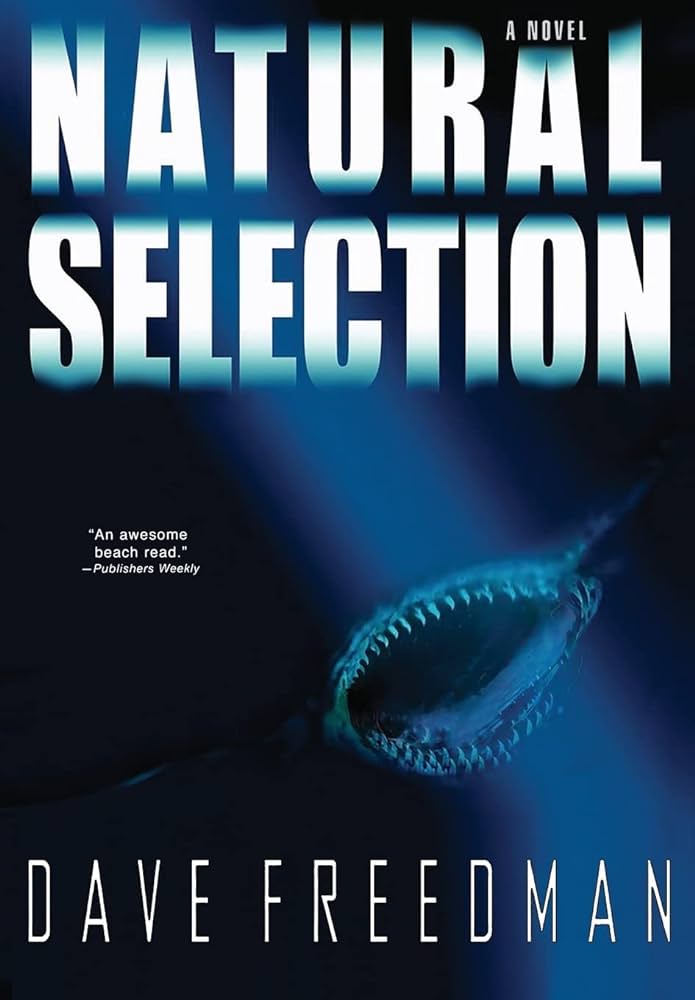
Title: Natural Selection
Author: Dave Freedman
Year: 2006
Publishing Details: Hyperion Books, First U.S. Mass Market Edition
Genre: Science Fiction, Horror
Topical Category: Eco-horror, Sea Monster, Animals Attack!
Synopsis and Background:
While Jaws (1974) spawned many imitators in the 70s and 80s, it’s position as a monster thriller was usurped in 1990 by the publication of bestseller Jurassic Park, a more science-centered take on the genre, but still packed with enough thrills to be a good pool or beach read. This explains why the People quote chosen for the cover of my copy of Natural Selection reads: “Combines the best of Jaws and Jurassic Park.”
I think this is an accurate description, with an emphasis on ‘combines’ not necessarily surpasses. The suspenseful stalking and alien intelligence of Benchley’s ‘super-predator’ is here as are the pseudo-philosophical musings on the nature of science, humanity, and hubris that are so much a feature of Crichton’s work (though not as adeptly handled).
David Freedman’s book begins with a Jurassic Park– esque prologue asking, “So could evolution make another monster? Today?” We are then taken to Clarita Island, off the coast of Los Angeles where a group of yahters come across a strange manta ray that belly flops onto their boat. Then, incredibly, it manages to launch it’s tiny airfoil-shaped body into the wind and fly over the side and escape.
One of the yahters reports this strange finding to man named Harry Ackerman (no relation to Frank Acreman from Megalodon). Harry is a ‘multi-millionaire’ who made his money in the dot-com boom but has since lost most of it through unfortunate investments including one Manta World, an unsuccessful for-profit aquarium. All of his mantas inexplicably died, but he still has a bunch of marine biologists on his payroll and he sends them to investigate the potential new ‘flying’ manta species.
Enter Lisa- the oceanic nutrition specialist, Daryll and his wife Monique who are ex-ROTC, Craig their best friend, Jason- manta expert and ‘male ambition in a wetsuit’, and Phil- Jason’s friend from college and the only one with no ichthyology PhD. Harry sends them to investigate the new manta ray species and it is quickly revealed that something scientifically unprecedented is occurring.
Manta rays, and rays generally, are extremely benign creatures. They lack teeth, being filter-feeders and spend most of their time swimming through the open ocean catching zooplankton. The largest species, Mobulus birostris, the giant manta ray, can grow to a wing-span of 23 ft. Manta rays do occasionally breach, maybe to shake loose parasites, maybe to impress potential mates, but they are not terribly graceful and can only jump about 2 meters. They are intelligent, for a fish, and endangered due to pollution, poaching and other threats.
Despite their previous appellation of ‘devil ray’ (due to their ‘horns’), manta rays are inoffensive creatures that never pose a threat to divers. Only one of the smaller species has a working tail stinger. Scuba divers in the past have been able to ride these gentle giants like living, underwater flying carpets.
The new ray species that Jason, Lisa, and their colleagues are about to discover is also intelligent. But they are not gentle filter feeders. Not by a long shot. Driven out of the depths, hungry and remorseless, they are quickly adapting to new sources of prey…
SPOILERS BELOW
My Thoughts:
The choice of a manta ray for a horror novel antagonist is an unexpected one (see above notes on mantas). But, man, does Dave Freedman pull it off. By page sixty a fiber-optic maintenance diver has gone missing and the reader is thoroughly unnerved by these new, intelligent-predator rays.
Part of crafting a successful monster, in writing or in film, is creating something that feels truly alien to humans. Rarely are the really terrifying monsters warm-blooded mammals like we are. How many killer gorilla movies have there been in the last 50 years? No, the truly successful antagonists are other, different. Like the ‘pitiless’ cruising of the great white shark, an ambush predator who dwells in an environment basically hostile to human life. Or the creeping, clawing terror of Alien (1979) with its acid blood and parasitic life-cycle. The hordes of reptilian monsters: pythons and anacondas, alligators and crocodiles, the bird-like raptors of Jurassic Park, etc. These creatures take us back to a time in humanity’s past when we were the hunted as often as the hunter. We are diurnal primates who rely heavily on vision to sense danger and in our endurance running to escape. And as a weak, clawless, fangless, soft-skinned species, we depend on our teamwork, intelligence, and our tools to give us the leg up on our potential predators. In single hand-to-claw combat we are easily defeated and devoured.
Trap us alone in an unfamiliar environment with obscured exits, with darkness that destroys our most valuable sense, and then take away our one edge? Make the monster as clever as we are? That’s terrifying. And some of the best monster stories do exactly that. Some even take it a step further like The Thing (1982) and tap into our other deep existential fears…that our fellow humans, the team we rely on for survival, might be monsters too, under the skin, ready to rip us apart and subsume us into the alien other when we lower our guard.
Natural Selection, especially in its third act, leverages all these fears: being the hunted, unfamiliar environments with obscured vision, failing tools, a super-intelligent predatory foe, and even a bit of betrayal by some of the people our protagonists trust and depend on for survival. The secondary ‘human’ antagonists (I won’t tell you who) also continue the fine tradition found in Ash from Alien, Burke from Aliens (1986), Nedry from Jurassic Park, etc. And as per usual the motive is greed. In the immortal words of Ellen Ripley, “I don’t know which species is worse. You don’t see them f*cking each other over for a goddamn percentage.”
Now, the demon rays.
The most memorable part of this book, the demon rays really shine. We follow their story nearly as closely as our human protagonists and we get frequent glimpses into their alien minds. They come up from the depths in search of food, some die and some survive to learn to hunt new prey. They learn to jump, then fly, catch seagulls, to hover, to leave the water entirely… Slowly, we focus our attention on a smaller and smaller group of rays. Then on one ray called ‘ the leader’. The leader is the only ray who has learned to make sounds a “deep, bass rumble” that evolves into a shattering roar. The leader learns to recognize human weapons, that humans are easy prey, that they can be lured using injured baby animals as sympathetic bait… In fine monster fashion, the demon rays don’t feel pain. Harpoons can’t stop them. Bullets don’t even slow them down. Dave also briefly implies that the demon rays hunted the megalodon to extinction. Always fun.
In addition, there are some interesting authorial choices here. For example real science blended thoroughly with made-up science by name dropping close-but-not-quite versions of actual events (the ‘terramouth’ shark vs. the ‘megamouth’ shark, for example. Or the ‘Quetzateryx’ which I think is a spin on ‘Hatzegopteryx’.) Perhaps this is supposed to be an alternate dimension that is subtly different from ours? Regardless, actual scientific research was clearly done before writing this book. I am not qualified to judge the accuracy of the physics by which the demon rays fly or the assessments of their brain shape and cognitive capacity. Brain anatomy is a bit beyond me and I am pretty sure the physics is bunko. But Dave Freedman does a good job making it sound convincing. And he reveals the capabilities of the rays bit by bit, just as the characters slowly discover more about them, which helps to hold interest.
His romantic writing leaves much to be desired in terms of realism and his dialogue sometimes borders on satire of what stock scientists would say, but Mr. Freedman does his best to inject some characterization. Jason’s trust issues were very believable. Our protagonists are also improbably good at convincing other people to listen to them and lend them equipment, but since the go-to for monster stories is usually ‘the threat is coming and no one will believe us!?!’ this is a nice change of pace. I also do not read books like this because I expect great human characterization or realistic dialogue so that was no obstacle to my enjoyment.
The number of times during my reading marathon a pointless sex scene does nothing to advance the plot: Still 3. (The hamfisted romance between Jason and Lisa is thoroughly off-camera, inoffensive, and incidental to the plot. No complaints from me.)
Rating:
3/3 Entertainment Value: This is one of the books I find myself reading at least once a year, and it pops up often in my thoughts. I recommend reading it! If nothing else, the pay off in the third act is worth the look.
2/3 Quality: This book is well put together and understandable. The prose never reaches any flowery heights, but everything is laid out in a logical manner. I believe this was a first novel so good job, Dave!
2/3 Originality: The comparison on the cover to Jaws and Jurassic Park is apt here. The major innovation is the choice of ray as antagonist. The use of Darryl’s semi-mystical Native American ancestry (à la ‘Billy’ in Predator (1987)) was especially cliché.
1/1 Exceeds Expectations: Refreshingly, probably because it was written in the current century, there is no racist claptrap to wade through here (with the exception of Darryl’s heritage-linked superpowers, see above). Lisa and Monique are thoroughly modern professional women and their male compatriots treat them as such. Unlike some 20th century novels, we aren’t expected to blithely agree with our male protagonists denigrating attitude towards women. And I always enjoy not having to do that.
Total Score: 8/10
Best Quote(s):
“The eyes. They were goddamn frightening eyes. Not just because they were bigger than baseballs, pupil-less, and in the strangely unnerving color of jet black. But because of what was behind them. They were cold, calculating, and, above all, intelligent. An awfully smart animal lurked behind those eyes…”
 Lady Scientist Reads
Leave a comment