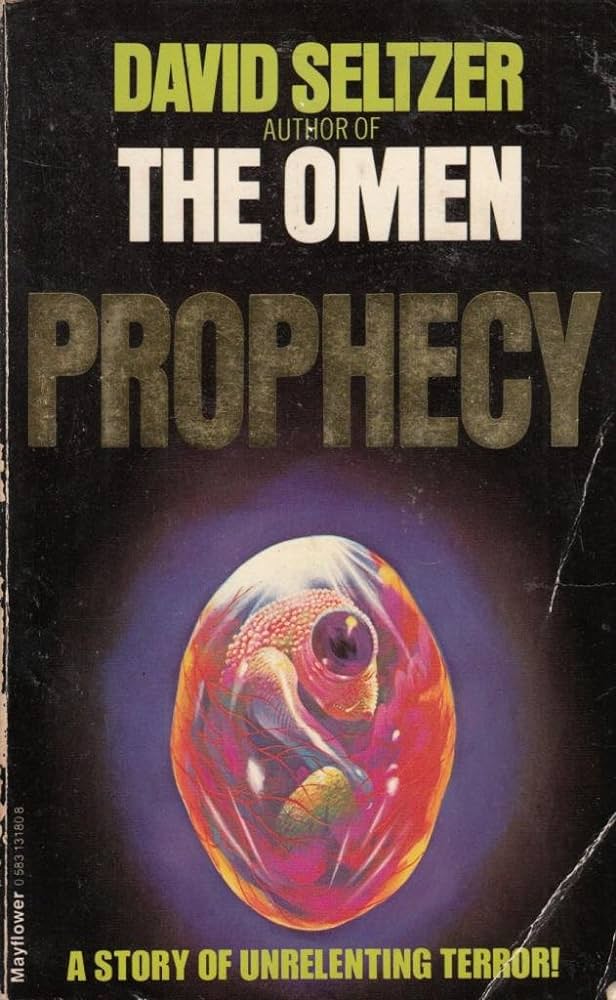
Title: Prophecy
Author: David Seltzer
Year: 1979
Publishing Details: Ballantine Books, Random House, Inc., First Edition February 1979
Genre: Science Fiction, Horror
Topical Category: Eco-horror, Mutant-on-the-loose
Synopsis and Background:
Rachel Carson published her environmental opus Silent Spring in 1962, warning about the harm done to the environment through the use of industrial pesticides. Its publication contributed to the growing impetus of an environmental movement, in the U.S. and around the world. In Europe a commission was formed for the protection of the Rhine river in 1963, in the United States the publication of The Population Bomb (1968) stoked fears of overpopulation while concerns over lead paint in ghettos sparked the beginning of the environmental justice movement.
In 1969 the Cuyahoga River, filled with industrial effluent and covered in oil slicks, caught fire (as it had many times before). The fire was quickly extinguished, but this time TIME magazine published an article heralding the event as part of ‘An Ecological Crisis’. In 1970, the Environmental Protection Agency was established, the Clean Air Act was passed, and the first Earth Day was celebrated. Through the rest of the 70s and 80s– through Love Canal, Chernobyl, the Endangered Species Act, and the Exxon-Valdez, the environmental movement fought tooth and nail and there were tragedies and victories. The battle continues today, of course.
But before Silent Spring, before the Cuyahoga, before Love Canal, there were the Four Big Pollution Diseases of Japan. In each case industrial discharge poisoned the local populations through their food, through air, through the water– with cadmium, with sulfur dioxide, with organomercury. Nothing much was done until the early 1960s, when the government intervened and the companies involved were forced to pay restitution.
And squarely into this global cultural soup of river pollution, overpopulation concerns, environmental justice, poisoned water, and organomercury dropped David Seltzer, author of the script for the movie The Omen. Mr. Seltzer was inspired and conceived of ‘a story of unrelenting terror’. His setting? A boreal forest in Northern Maine. The victimized population? The Native Americans whose ancestral home was the Manatee forest. The polluter? A papermill, just like in Minamata, Japan. But instead of only the (already horrific) environmental consequences of this real disaster, he introduced something new.
Something monstrous.
Our main characters for this story of unrelenting terror are Robert Vern from the Department of Public Health. He is dispirited after years of losing battles trying to improve the lives of people in D.C. tenements. A friend requests his help with the situation in Maine. The American Indians and the Pitney Paper Mill are stuck in a deadlock. The paper mill insists they have done nothing wrong, the Indians insist that the mill is destroying their home and have formed a blockade. The blockade was declared illegal, but the ‘Original People’ as they call themselves refuse to back down. The situation is a powder keg. Robert’s friend from the EPA wants him to use his determination and social acumen to diffuse the situation and write an unbiased environmental report to decide the issue.
Meanwhile, Robert’s wife Maggie, a cellist, is grappling with news of a pregnancy. She desperately wants children but due to Robert’s fears of overpopulation and environmental misery, her husband has stated many times that having children is ‘wrong’ and ‘irresponsible’. Something will need to give, but only after Maggie drums up the courage to actually *tell* Robert. In the meantime, they both set off for Maine.
Two secondary characters are already there. John Hawks, an Indian raised at a white boarding school and alienated from his people has come home to a disaster. The people of his village are sick with unexplained seizures, they are accused of murdering some missing lumberjacks from the paper mill, they are accused of being drunks because they have become sick, disoriented, hallucinating… His ex-girlfriend Ramona Peters has been trying to solve another mystery. All through the village, native women have been giving birth to malformed and stillborn babies. Some even look more animal than human. Wary of asking for help from the hostile white population, John and Ramona both know that something needs to be done for their people. And they are ready to fight.
But what happened to the missing lumberjacks? If it wasn’t the Indians… And what happened to the rescue team sent to find the lumberjacks? The one that never returned? According to Ramona’s grandfather, a creature named katahdin, a mixture of ‘every creature in creation’ has appeared to defend the forest.
Katahdin or not. Something lurks in the Manatee Forest. And Robert and Maggie, John and Ramona are about to become intimately acquainted with it.
SPOILERS BELOW
My Thoughts:
This book, adapted from Seltzer’s movie script, is a fantastic example of horror being informed by real life concerns. It is clear that Seltzer did his homework and the care with which he fleshes out his characters and their environment turns something that could have been a cheapie ‘monster-on-the-loose’ or ‘Jaws-knockoff’ into something inspired. The movie itself suffered from a limited budget and limited effects technology. But the book is limited only by your ability to imagine. I can highly recommend watching the movie as well (plus its fantastic teaser trailer), but the book manages to transcend the limits of late 70s filmmaking.
The intro is excellent, and throughout the book the menace of ‘Katahdin’ is built up gradually with a less-is-more approach that I appreciated. But I also appreciated that once we got to the real meat of the monster action it was no-holds-barred. The descriptions of the creature’s ‘fish-like’ or ‘saucer-like’ eyes was especially chilling, an example of the same neoteny that makes gray aliens or the babies from It’s Alive (1974) so grotesque.
I also liked the compare-contrast that the novel accomplished with Robert and Maggie and John and Ramona, two very different couples in very different circumstances, but all dedicated to helping others and trying to do what’s right with the means that they have. John and Ramona whose means are limited by prejudice, bigotry, economics, and credibility really shine as realistic and flawed humans, but also impressive in their sheer determination. Robert and Maggie have greater means due to their race, education, and government employ, but are also afflicted with greater self-doubt and uncertainty. But between them, they all share a drive to persevere and survive. I was sad when not all of them made it.
To my knowledge this is the only monster novel to directly tie its mutant to bioaccumulation of mercury and take the time to explain the process. The science overall is excellent, if now outdated. Methyl-mercury is indeed one of a handful of heavy metal toxicants (arsenic, lead, etc.) that can cross the placental barrier and concentrate in fetal cells. The assertion that ‘ontogeny recapitulates phylogeny’ is a bit dated, however. Embryos do indeed go through distinct stages that ‘recapitulate’ their evolutionary history. For example, dolphin embryos grow and then reabsorb leg buds since their ancestors had legs. All vertebrates develop pharyngeal slits as embryos, but only some grow up to have gills. In mammals, for example, the slits become the tissues of the jaw and ear bones and glands like the thyroid instead of becoming gill bars.
That being said, a human embryo never “has fins and gills” or “looks feline” so Robert is hyperbolic and wrong there. And as far as I know ‘freezing’ different parts of a life form at different ‘stages of evolution’ would just result in a non-functioning organism that, for example, never developed an aorta or something else important. But this is a monster novel, not a research paper.
I recommend reading this one!
The number of times during my reading marathon a pointless sex scene does nothing to advance the plot: Still just 1 (The sex scene here was very tasteful and smoothly incorporated into the plot. It worked thematically, as the generation of children/young is central to the novel’s conflict and also to Maggie’s internal conflict.)
Rating:
3/3 Entertainment Value: I was very entertained. I would go so far as to call the book engrossing. The suspense was handled with a deft hand and the payoff was worth it.
3/3 Quality: Seltzer is a professional and it shows. This book is tightly plotted, well-edited, lacking in filler, well-proofread, and the word choice is concise, informative, and to-the-point.
2/3 Originality: The monster plot has been done before, however unique the monster is. And the overworked idealistic doctor, the couple with marital communication problems, the persecuted Native Americans, the belligerent corporate stooge are all retreads, though they do reflect reality and Seltzer does a decent job giving them some personality in the limited space he has.
1/1 Exceeds Expectations: Despite some unfortunate ‘of the times’ terminology, for example ‘blacks’, this novel does try to combat some negative stereotypes. The characters who go out of their way to be racist asshats are clearly the bad guys and if anything the emphasis is on everyone’s common humanity. The female characterization is pretty good for this time and type of media as well. Maggie and Ramona have agency and internal conflicts and it is pretty clearly shown that while Maggie’s race and status protect her from some of the abuse Ramona suffers as a woman of color, she is still hemmed in and repressed in other ways by a society where, as we see, the police, medicine, industry, government, and nearly everything else is run by men.
Total Score: 9/10
Best Quote(s):
“In environmental drama the term science fiction will soon be obsolete. Our imaginations have limits. And our realities are catching up with them.”
“The head of the bear was devoured on the spot, the body carried back to the den among the cliffs. There it would be eaten at leisure, its bones thrown onto the pile of carcasses that would grow higher throughout the spring, creating a macabre scaffolding that would reach to the top of the thirty-foot walls. The architect of this cavern had no taste for hooves and claws; they had been severed and left rotting on the earthen floor.
Before long, hands and feet would lie rotting there, too…”
 Lady Scientist Reads
Leave a comment